
Ein Guide für Friedrichshain
Friedrichshain ist eines der charaktervollsten Viertel Berlins: teils ehemaliges Ostberlin, teils alternativer Treffpunkt, teils Zentrum des Nachtlebens und zunehmend einer der begehrtesten Orte der Stadt zum Wohnen und Besuchen. Es verbindet monumentale DDR-Architektur mit graffitibedeckten Industrieflächen, grünen Parks, unabhängigen Bars, Restaurants, Galerien und einigen der berühmtesten Ausgehmöglichkeiten Berlins.
Culture • Practical Tips • Food • Tours • 7 Min. Lesezeit
Das Gebiet, das wir heute Friedrichshain nennen, bestand bis zur rasanten industriellen Expansion Berlins im 19. Jahrhundert größtenteils aus Feldern, Gärten und kleinen Siedlungen. Der Name leitet sich vom Friedrichshain-Park ab, der in den 1840er Jahren angelegt und zu Ehren Friedrichs des Großen benannt wurde. Im Zuge der Industrialisierung Berlins entwickelte sich Friedrichshain zu einem dicht besiedelten Arbeiterviertel mit Fabriken, Eisenbahnwerkstätten und Mietshäusern.
Der Bezirk erlitt während des Zweiten Weltkriegs enorme Zerstörungen und wurde anschließend Teil von Ostberlin. Die DDR hinterließ besonders sichtbare Spuren durch Projekte wie die Karl-Marx-Allee, den monumentalen sozialistischen Boulevard, der ursprünglich als Stalinallee bekannt war.
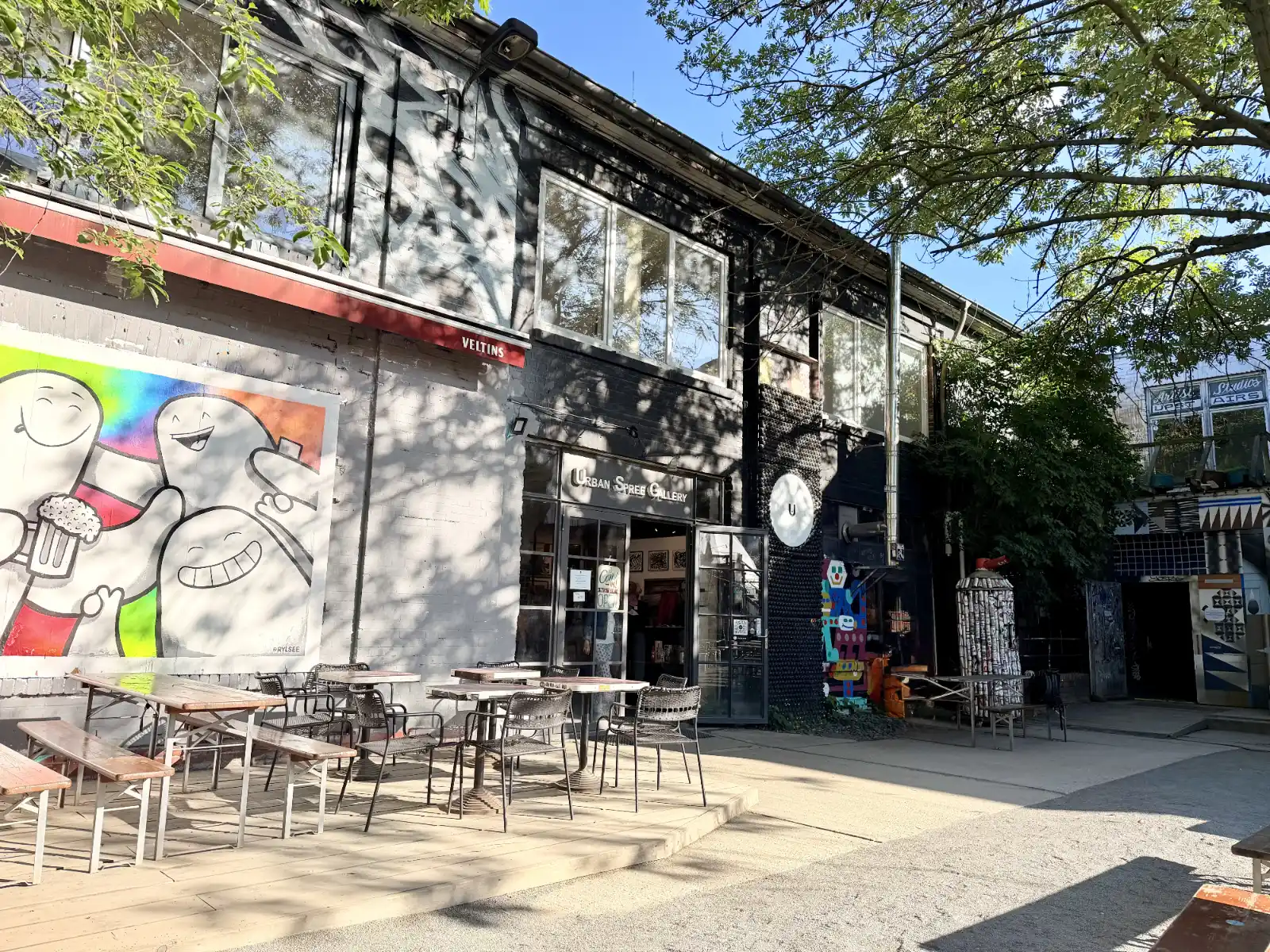
Nach dem Fall der Berliner Mauer durchlief Friedrichshain einen weiteren dramatischen Wandel. Ehemalige Fabrik- und Bahnanlagen wurden von Künstlern, Musikern, Clubs und alternativen Kulturprojekten besetzt oder umgenutzt. Orte wie das RAW-Gelände wurden zu Symbolen des neuen Berlins: etwas rau, kreativ, experimentierfreudig und ein wenig unberechenbar.
Heute ist es genau diese Mischung aus Geschichte und Neuerfindung, die Friedrichshain so interessant macht. Hier ist eine Liste mit Dingen, die man dort, unserer Meinung nach, unbedingt unternehmen sollte:
1. Spaziergang entlang der East Side Gallery
Kein erster Besuch in Friedrichshain ist vollständig ohne einen Spaziergang entlang der East Side Gallery. Sie erstreckt sich über rund 1,3 Kilometer entlang eines erhaltenen Abschnitts der Berliner Mauer und wurde nach dem Fall der Mauer von internationalen Künstlern in eine Freiluftgalerie verwandelt.
Die Wandgemälde reichen von farbenfroh und verspielt bis hin zu zutiefst politisch – hier finden sich einige der bekanntesten Bilder Berlins. Der berühmte „Brüderkuss“ ist ein naheliegender Fotostopp, aber es lohnt sich, sich Zeit zu nehmen und auch die weniger bekannten Werke anzuschauen.
Die Galerie ist mehr als nur Street Art: Sie erinnert daran, wie schnell sich Berlin nach 1989 verändert hat und wie eine politische Grenze zu einer Leinwand umgestaltet wurde.
Am besten geeignet für: Geschichte, Fotografie, Street Art und Erstbesucher.
2. Entdecken Sie das RAW-Gelände
Um einen Eindruck von der alternativen Seite Friedrichshains zu bekommen, sollten Sie das RAW-Gelände rund um die Revaler Straße besuchen.
Das Gelände war ursprünglich ein Eisenbahnreparaturkomplex mit einer mehr als 150-jährigen Industriegeschichte. Nach der Schließung der Eisenbahnwerkstätten wurden die leerstehenden Gebäude nach und nach von Künstlern, Kulturprojekten, Clubs, Bars, Sportstätten und kreativen Unternehmen bezogen.
Heute können Sie mehrere Aktivitäten in einem Besuch verbinden: Street-Art bewundern, über den Sonntagsflohmarkt schlendern, klettern oder skaten gehen, etwas essen, ein Konzert besuchen oder einfach durch die Industriegebäude bummeln.
Das RAW-Gelände ist zudem ein gutes Beispiel für den anhaltenden Konflikt in Berlin zwischen alternativer Kultur, kommerzieller Entwicklung und steigenden Immobilienpreisen. Im August 2026 wurde eine Vereinbarung getroffen, die darauf abzielt, Clubs, Bars, Ateliers und kulturelle Nutzungen auf dem Gelände zu sichern und gleichzeitig den Bau neuer Wohnungen zu ermöglichen.
Tipp für einen besonderen Ausflug: Der RAW-Flohmarkt findet jeden Sonntag statt und vereint Vintage-Kleidung, Kuriositäten, lokale Kunst und Street Food.
3. Friedrichshain von der Karl-Marx-Allee aus entdecken
Wenn Sie einmal etwas ganz anderes als Berlins mit Graffiti übersäte alternative Orte erleben möchten, machen Sie einen Spaziergang entlang der Karl-Marx-Allee.
Der riesige Boulevard ist eines der eindrucksvollsten Beispiele für DDR-Architektur in Berlin. Er wurde größtenteils in den 1950er- und frühen 1960er-Jahren erbaut und sollte die Macht und das Selbstbewusstsein des sozialistischen Staates verkörpern. Die riesigen Wohnblocks wurden bekanntlich als „Paläste für Arbeiter“ konzipiert.
Achten Sie auf Details wie die kunstvollen Fassaden, die gewaltigen Ausmaße, das Kino International und das ehemalige Café Moskau. Der Kontrast zwischen der Karl-Marx-Allee und den nahegelegenen alternativen Straßen ist faszinierend: Innerhalb eines relativ kurzen Spaziergangs gelangen Sie von monumentaler sozialistischer Architektur zu Graffiti, unabhängigen Bars und Nachtleben.
So erleben Sie es am besten: Nehmen Sie an unserer Tour „Von Karl Marx zur Berliner Mauer: Kommunismus, Kalter Krieg und Ostberlin“ teil, um tiefer in die Geschichte und Politik der Gegend einzutauchen.
4. Besuchen Sie das Computerspielemuseum
Friedrichshain hat ein hervorragendes Museum für alle, die mit einem Game Boy, einer PlayStation, einem Commodore oder einem Spielautomaten aufgewachsen sind – und es ist überraschend interessant, auch wenn man kein Hardcore-Gamer ist: das Computerspielemuseum.
Das Museum beleuchtet die Geschichte digitaler Spiele und interaktiver Unterhaltung mit historischen Konsolen, Computern, Spielen und interaktiven Exponaten. Es bietet eine unterhaltsame Alternative zu den eher traditionellen Museen Berlins und eignet sich besonders gut für einen regnerischen Nachmittag.
Dank seiner Lage direkt an der Karl-Marx-Allee lässt es sich zudem gut mit einem Architekturrundgang durch das ehemalige Ostberlin verbinden.
Am besten geeignet für: Familien, Fans von Retro-Spielen, Technikbegeisterte und regnerische Tage.
5. Bummeln am Boxhagener Platz
Der Boxhagener Platz, liebevoll „Boxi“ genannt, liegt im Herzen eines der lebhaftesten Viertel Friedrichshains.
Unter der Woche ist der Platz, umgeben von Cafés, Restaurants und Bars, ein angenehmer Ort, um zu sitzen und das lokale Treiben zu beobachten. Sonntags wird es hier dank des berühmten Flohmarkts besonders lebhaft.
Die umliegenden Straßen – insbesondere die Simon-Dach-Straße, die Krossener Straße und die Grünberger Straße – sind voller Lokale, in denen man essen und trinken kann. Es ist eine gute Gegend, um ohne festen Plan unterwegs zu sein: Trinken Sie einen Kaffee, stöbern Sie in den Geschäften, essen Sie zu Mittag und lassen Sie sich vom Nachmittag treiben.
Am besten geeignet für: Essen, Cafés, Leute beobachten, Einkaufen und Nachtleben.
6. Entdecken Sie die unabhängige Kunstszene Friedrichshains
Friedrichshain hat nicht nur riesige Wandmalereien zu bieten. Das Viertel verfügt auch über kleinere unabhängige Galerien, in denen Sie zeitgenössische Künstler und Ausstellungen bewundern können, ohne extra zur Museumsinsel fahren zu müssen.
Eine Möglichkeit ist die Galleri Heike Arndt DK in der Voigtstraße, die sich auf zeitgenössische Kunst konzentriert und regelmäßig ihre Ausstellungen wechselt.
Für ein spontanes Kunsterlebnis sollten Sie das Programm auf dem RAW-Gelände im Auge behalten, wo neben Musik und Nachtleben regelmäßig Ausstellungen, Performances, Workshops und kreative Projekte stattfinden.
Das ist einer der Reize von Friedrichshain: Man muss nicht unbedingt ein großes Museum betreten, um Kunst zu erleben. Sie kann an einer Wand zu sehen sein, in einem alten Industriegebäude, in einer winzigen Galerie oder ganz unerwartet in einem Club.
Am besten geeignet für: zeitgenössische Kunst, alternative Kultur und Besucher, die unabhängige Räume den großen Museen vorziehen.
7. Entspannen Sie sich im Volkspark Friedrichshain – und schauen Sie sich einen Film unter freiem Himmel an
Neben all der Architektur, den Museen, der Straßenkunst und dem Nachtleben hat Friedrichshain auch eine überraschend grüne Seite.
Der Volkspark Friedrichshain ist einer der ältesten öffentlichen Parks Berlins und ein großartiger Ort, um zur Ruhe zu kommen. Man kann durch den Park spazieren, den Märchenbrunnen entdecken, das Grün genießen oder einfach eine Auszeit von den belebten Straßen nehmen.
Für ein besonderes Sommererlebnis sollten Sie sich das Freiluftkino Friedrichshain im Park nicht entgehen lassen. Die Saison 2026 begann im Mai und umfasst Filmvorführungen unter dem Nachthimmel sowie besondere Filmveranstaltungen.
Das ist eine besonders gelungene Abendkombination: Abendessen in der Nachbarschaft, ein Spaziergang durch den Park und anschließend ein Film unter freiem Himmel.
Am besten geeignet für: Parks, Familien, Paare, Sommerabende
Das Friedrichshain-Erlebnis
Das Besondere an Friedrichshain ist die schiere Vielfalt an verschiedenen Facetten Berlins, die auf relativ kleinem Raum vereint sind. Man kann den Tag mit DDR-Architektur an der Karl-Marx-Allee beginnen, an der East Side Gallery die in Kunst verwandelte Berliner Mauer bewundern, im RAW einen alten Bahnbetriebshof erkunden, in einem Restaurant rund um den Boxhagener Platz essen und den Abend in einer Bar, einem Club oder einem Open-Air-Kino ausklingen lassen.
Und das Viertel verändert sich weiterhin. Die alternative Kultur Friedrichshains steht unter dem Druck von Bebauung und steigenden Mieten, doch viele seiner kreativen Räume passen sich weiterhin an und bestehen fort. Diese Spannung zwischen Alt und Neu, Ost und West, Industrie und Kreativität, Lokal und International ist vielleicht der beste Weg, den Stadtteil heute zu verstehen.
Um tiefer in die Geschichte der Hausbesetzerkulturen, der Street Art, der Musik und der Gentrifizierung in Berlin einzutauchen, nehmen Sie an unserer Alternative Berlin Tour: Straßenkunst und Gegenkultur in Kreuzberg teil.
Verwandte Geschichten
Practical Tips • History • 13 Min. Lesezeit
Die 11 besten Parks in Berlin: Die grünen Lungen der Stadt
Entdecken Sie die 11 besten Parks und Gärten Berlins. Vom Tiergarten bis zum Tempelhofer Feld: die grünsten Orte der Stadt.

Practical Tips • History • 10 Min. Lesezeit
Ein Leitfaden für den öffentlichen Nahverkehr in Berlin
U-Bahn, S-Bahn, Busse, Tram: Alles Wissenswerte zum öffentlichen Nahverkehr in der deutschen Hauptstadt
Practical Tips • 5 Min. Lesezeit
Ist Berlin familienfreundlich? Ein Ratgeber zu Parks, Museen und Nahverkehr
Planen Sie einen Familientrip in die deutsche Hauptstadt? Dieser Ratgeber bietet praktische Tipps zu Berlins Parks, interaktiven Museen und der Nutzung öffentlicher Verkehrsmittel mit Kindern.
Culture • 3 Min. Lesezeit
Berlin nach dem Mauerfall: Die Ursprünge einer subkulturellen Bewegung
Erfahren Sie, wie der Mauerfall 1989 Berlin durch leerstehende Räume in ein Zentrum für Street Art, Techno und alternative Kultur verwandelte.
Culture • Practical Tips • 4 Min. Lesezeit
Die 7 besten Souvenirs, die man in Berlin kaufen kann
Unser Guide zu den besten Souvenirs aus Berlin. Entdecken Sie authentische DDR-Andenken, das kultige Ampelmännchen, die originale Currywurst-Sauce und einzigartige Street-Art-Drucke.
Unsere Städte
57Die besten kostenlosen und bezahlten Walking‑Touren
Unternehmen

Rechtliches