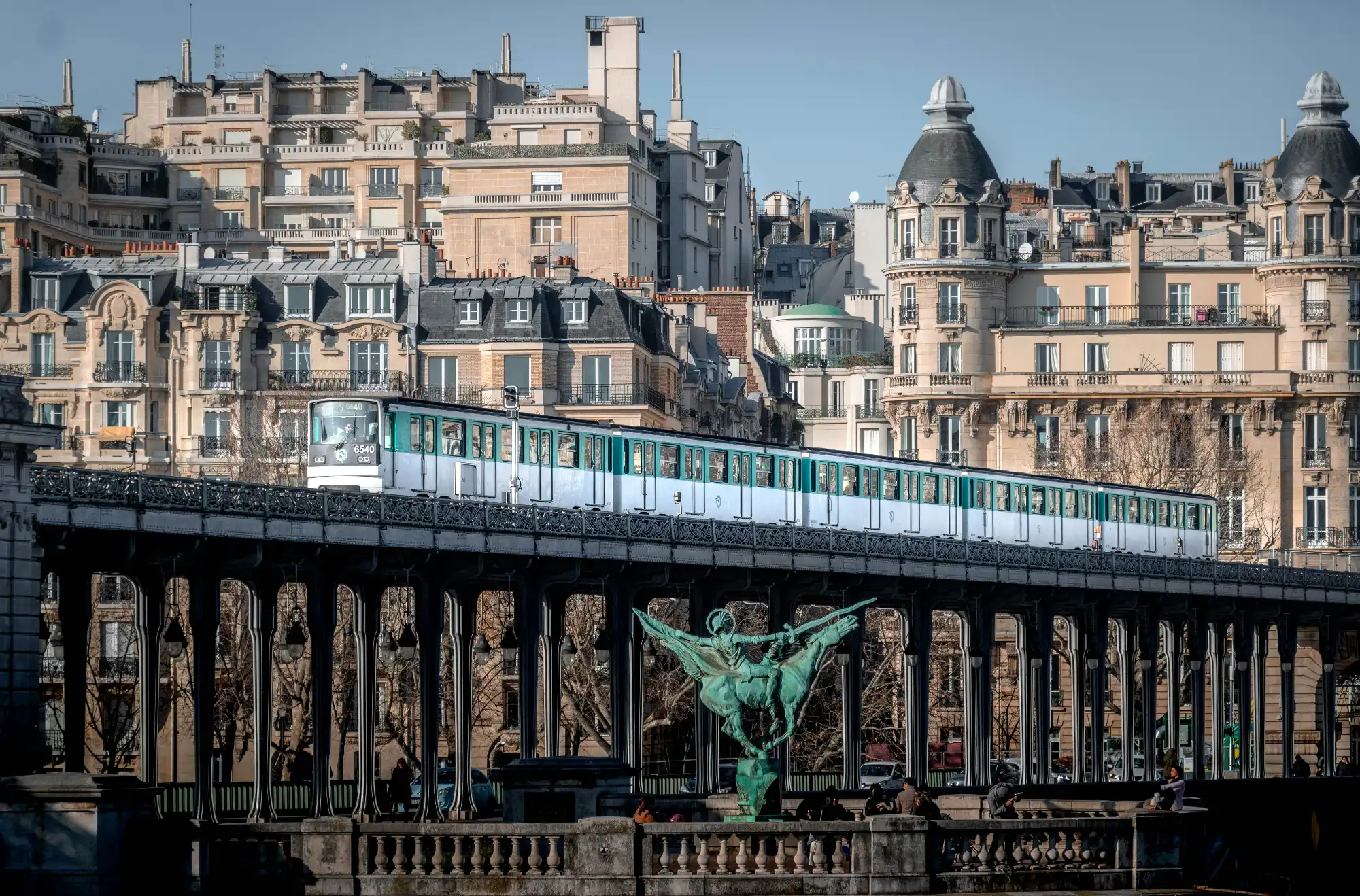
Public Transport in Paris 2026-2027: What's New and How to Get Around
Planning a trip to Paris? From the Metro and RER to buses, airport transfers and journeys to Disneyland Paris or Versailles, this practical guide explains everything you need to know about getting around the French capital.
Practical Tips • 11 min. read
Last edited:
Visiting Paris for the first time? One of the easiest ways to explore the French capital is by public transport.
Paris has an extensive network of Metro lines, RER trains, buses, trams and funiculars, making it possible to reach almost every major attraction without needing a car. The system can look complicated at first, especially when you arrive from the airport, but once you understand the basics, getting around Paris is surprisingly simple.
This guide explains how Paris public transport works in 2026, which tickets to buy, how to get from the airports, and how to reach the city's most popular attractions.
Paris public transport at a glance
For most tourists, you will mainly use three types of transport:
Metro – The easiest option for travelling around central Paris. There are 16 Metro lines and hundreds of stations across the city.
RER – Faster regional trains that connect Paris with the suburbs and major destinations such as Versailles, Disneyland Paris and the airports.
Bus – A slower but more scenic way to travel. Buses can be particularly useful when you want to see the city while travelling.
You may also use trams, particularly if you are travelling around the outer parts of Paris.
The network is operated within the Île-de-France transport system, with journey planning and ticketing managed through Île-de-France Mobilités.
How much does public transport cost in Paris in 2026?
The Paris ticketing system changed significantly in recent years, making it simpler than before.
For 2026, a standard Metro-Train-RER ticket costs €2.55. A standard Bus-Tram ticket costs €2.05.
The important thing to remember is that Metro/RER tickets and Bus/Tram tickets are separate ticket types.
If you are staying in Paris for several days, however, buying individual tickets for every journey may not always be the best option.
The main options for tourists
Ticket | 2026 price | Best for |
|---|---|---|
Metro-Train-RER ticket | €2.55 | Individual Metro/RER journeys |
Bus-Tram ticket | €2.05 | Individual bus or tram journeys |
Navigo Day | €12.30 | A day with lots of travel |
Navigo Week | €32.40 | Travelling extensively for a full week |
Paris Visite | From €30.60 | Tourists wanting unlimited travel |
Airport ticket | €14 | Journey to/from CDG or Orly |
Prices are based on 2026-2027 full fares.
Which Paris transport ticket should a tourist buy?
This is probably the question visitors ask most often.
Staying for 1–3 days?
For a short city break, you can usually use individual Metro-Train-RER and Bus-Tram tickets, depending on how much you travel.
Another option is the Navigo Day pass, which costs €12.30 and provides unlimited travel for the day within the zones covered by the pass.
If you expect to take several journeys in one day, this can be convenient.
Staying for 4–7 days?
Look at the Navigo Weekly pass.
The 2026 all-zones price is €32.40 and provides unlimited travel across zones 1–5.
There is one important catch: the weekly pass runs from Monday to Sunday, rather than for seven days from the moment you purchase it.
So if you arrive on Thursday and leave the following Wednesday, it may not be the best option.
Want an unlimited tourist pass?
The Paris Visite pass is specifically designed for visitors.
In 2026, prices start at €30.60 for one day and go up to €78 for five days, depending on the duration and coverage selected.
It can be useful if you want a straightforward unlimited-travel option and do not want to calculate individual journeys.
What about the Navigo Easy pass?
The Navigo Easy is a rechargeable physical transport card designed for occasional travellers.
The card itself costs €2 and can be loaded with different types of tickets.
It can be a convenient option if you do not want to use your phone for every journey.
The old cardboard ticket system has largely disappeared, so tourists should not expect to buy the traditional booklets of paper Metro tickets they may remember from older Paris guides.
Can you use your phone to travel?
Yes.
In 2026, many Paris transport tickets can be purchased and stored digitally on a compatible smartphone.
The Île-de-France Mobilités app supports Metro-Train-RER tickets, Bus-Tram tickets, airport tickets, Paris Visite and several Navigo passes.
This is particularly useful for tourists because you can prepare your tickets before travelling and avoid searching for a ticket machine every time you enter a station.
Tip: Make sure your phone has enough battery before relying on it as your transport ticket.
How to get from Charles de Gaulle Airport to Paris
Charles de Gaulle (CDG) is Paris's largest airport.
The easiest public transport option for many visitors is the RER B.
The RER B connects the airport with central Paris and stops at major stations including:
Gare du Nord
Châtelet–Les Halles
Saint-Michel–Notre-Dame
Luxembourg
The 2026 airport ticket costs €14 per journey.
The journey to central Paris generally takes around 30–40 minutes, depending on your destination.
A useful tip
Be careful when following older online guides recommending RoissyBus.
The transport network has changed, and Île-de-France Mobilités announced the end of the RoissyBus service in 2026. The RER B is now particularly important for public transport journeys between CDG and Paris.
How to get from Orly Airport to Paris
Orly Airport is much closer to central Paris than CDG.
The easiest public transport option is usually Metro Line 14.
Line 14 now extends to Orly Airport, providing a direct connection between the airport and Paris.
The 2026 Paris Region ↔ Airports ticket costs €14 and covers the journey to or from Orly via Metro Line 14.
For many tourists, this is one of the simplest airport transfers in Paris.
How to reach the Eiffel Tower
The Eiffel Tower is served by several Metro and RER stations.
The closest options include:
Bir-Hakeim – Metro Line 6
Trocadéro – Metro Lines 6 and 9
École Militaire – Metro Line 8
Champ de Mars–Tour Eiffel – RER C
There is no single "Eiffel Tower station", so choose the station based on where you are coming from and whether you want to approach the tower from the Trocadéro side or the Champ de Mars.
For first-time visitors, Trocadéro is particularly popular because it provides one of the classic views towards the Eiffel Tower.
How to reach the Louvre
The easiest station for the Louvre is generally:
Palais Royal – Musée du Louvre
It is served by Metro Lines 1 and 7.
Another useful option is Louvre–Rivoli on Line 1.
If you are visiting the Louvre, remember that the museum is enormous. Getting off at the right station can save you a considerable amount of walking.
How to reach Notre-Dame
For Notre-Dame Cathedral, useful stations include:
Cité – Metro Line 4
Saint-Michel–Notre-Dame – RER B and RER C
Châtelet – several Metro and RER connections
The area around Notre-Dame is also ideal for exploring on foot, so consider combining public transport with walking.
How to reach Montmartre and Sacré-Cœur
Montmartre is on a hill, so your choice of station matters.
The most useful Metro stations include:
Anvers – Line 2
and
Abbesses – Line 12
You can then walk uphill towards Sacré-Cœur.
Another option is the Montmartre funicular, which takes passengers up the hill and is integrated into the Paris public transport system.
If you are visiting Montmartre, comfortable shoes are highly recommended!
How to get to Versailles from Paris
The Palace of Versailles is outside central Paris, so you will need regional transport.
The easiest option for most visitors is the RER C.
Get off at:
Versailles Château–Rive Gauche
From there, the palace is approximately a 10-minute walk.
Remember that your normal central-Paris Metro ticket is not necessarily the correct ticket for this journey. Make sure you have a valid ticket covering your complete route.
How to get to Disneyland Paris
Disneyland Paris is located outside the city centre at Marne-la-Vallée–Chessy.
The easiest way to reach the resort from central Paris is generally the RER A.
The journey takes approximately 40 minutes from central Paris, depending on your departure station.
One important point for 2026: check the RER A service before travelling. Temporary works can affect sections of the line, particularly during summer periods. Paris's tourist office advises visitors to check for current disruptions before travelling to Disneyland.
Should tourists use the bus?
Absolutely.
The Metro is usually faster, but buses have one major advantage: you can see Paris while you travel.
A bus journey can take you past monuments, historic streets and neighbourhoods that you would miss underground.
Buses can be particularly useful for journeys such as:
Eiffel Tower → Champs-Élysées
or
Louvre → Opéra → Montmartre
The standard 2026 Bus-Tram ticket costs €2.05.
What time does the Paris Metro stop?
The Metro does not run all night.
On most days, services generally finish around 1:15 a.m., while on Friday and Saturday nights and the evenings before public holidays, services generally run later, until around 2:15 a.m.
After the Metro closes, Noctilien night buses provide overnight services on many routes.
If you are staying out late in Paris, check your route home before leaving your hotel or restaurant.
What about taxis and Uber?
Public transport is usually the cheapest way to move around Paris, but taxis and ride-hailing services can be useful when:
You have heavy luggage
You are travelling with young children
You are returning late at night
You are travelling in a group
Public transport is disrupted
Your accommodation is far from a Metro station
For airport journeys, official taxis also have regulated flat fares to and from central Paris, so it is worth checking the current official airport information rather than accepting an unsolicited offer from someone inside the terminal.
Is Paris public transport safe?
Paris public transport is generally safe, but tourists should be particularly careful about pickpocketing, especially in crowded Metro trains, major stations and around tourist attractions.
Keep your phone and wallet secure and be particularly alert when:
Boarding a crowded train
Standing near Metro doors
Looking at a map on your phone
Travelling through major interchange stations
Visiting busy tourist attractions
Be wary of anyone offering unsolicited help with tickets or asking you to purchase something at a ticket machine.
If you need assistance, use official staff or the station information desk.
A simple strategy for your Paris trip
For most tourists, public transport does not need to be complicated.
A good approach is:
1. From the airport:
Use the dedicated airport transport option.
2. Around central Paris:
Use the Metro and walk between nearby attractions.
3. For sightseeing:
Consider the bus when the route passes through interesting parts of the city.
4. For Versailles:
Use the RER C.
5. For Disneyland Paris:
Use the RER A, checking for current works before travelling.
6. For late nights:
Check the final Metro times and use Noctilien buses if necessary.
7. Before every important journey:
Check the current route and disruptions using Île-de-France Mobilités.
The best Paris transport apps
Before your trip, it is worth having at least one journey-planning app on your phone.
The official Île-de-France Mobilités app can be used to find routes, check transport information and purchase a range of tickets.
The official Paris je t'aime tourist website is also useful for visitors looking for practical information about public transport, attractions and current disruptions.
Paris public transport: F&Q
What is the cheapest way to get around Paris?
For occasional journeys, individual tickets are often the simplest option. If you plan to travel extensively during one day, compare the cost with the €12.30 Navigo Day pass.
Can I use one ticket for the Metro and bus?
Not always. Metro-Train-RER tickets and Bus-Tram tickets are separate ticket types in the 2026 fare system.
Can I use my bank card?
Contactless and digital payment options are increasingly available, but availability depends on the service and ticket type. Purchasing the appropriate digital ticket or using a Navigo Easy card can be simpler. Now on the bus you can pay just by card.
Do children need tickets?
Yes, but reduced fares may apply depending on the ticket and the child's age. For example, the Paris Visite pass has a reduced rate for children aged 4 to under 10.
Final tips for using public transport in Paris
Paris is much easier to explore when you combine public transport and walking.
You do not need to take the Metro for every journey. Many famous sights are relatively close together, and walking between them can be one of the best ways to experience the city.
Welcome to Paris — and enjoy the journey.
Written by
Eva Serrano
Im Eva I studied Art History and Cinema, with a particular focus on French cinema, and have spent the past eight years guiding travelers through the Paris I first discovered through literature, film, poetry. My tours are driven by storytelling, bringing to life the writers, historical figures, artists, thinkers who shaped Paris its endlessly fascinating to me.
Related stories

Culture • Practical Tips • Food • 9 min. read
Alternative Paris: 10 Off‑the‑Beaten‑Path Spots
Discover Alternative Paris: 10 off-the-beaten-path spots beyond Champs-Élysées and Notre-Dame, where locals find creative, multicultural life.If you want to see the Paris locals actually live in, this is where to start.

Practical Tips • Food • 5 min. read
Paris Catacombs: The Mysterious World Beneath the City of Light
Beneath the romantic streets of Paris lies a hidden labyrinth filled with history, mystery, and millions of human remains. The Catacombs reveal a darker, fascinating side of the City of Light that few truly understand.

Practical Tips • 13 min. read
Paris in 3 days - how to visit the city of lights?
Paris in 3 days: a practical itinerary with key sights, neighbourhood walks, museums, and food stops. Tips for getting around and timing.

Culture • History • 7 min. read
Le Marais: Everything You Want to Know About Paris’s Most Unique Neighborhood!
Discover Le Marais, the most unique neighborhood in Paris. Learn about its history, architecture, and top spots.

Practical Tips • History • 5 min. read
🌿 The Best Parks in Paris: A Local’s Guide to Green Escapes in the City of Light
Discover the best parks in Paris, from famous gardens to hidden green escapes. Plan your perfect relaxing day in the City of Light.