The Top 5 Things to See and Do in Potsdam
Just a short journey from Berlin, Potsdam is a city where royal grandeur, fascinating history, and beautiful landscapes come together. Once the residence of Prussian kings, it is famous for its magnificent palaces, picturesque gardens, charming historic streets, and its important role in shaping European history.
Culture • Practical Tips • History • 8 min. read
Last edited:
Just a short journey from Berlin, Potsdam is a city where royal grandeur, fascinating history, and beautiful landscapes come together. Once the residence of Prussian kings, it is famous for its magnificent palaces, picturesque gardens, charming historic streets, and its important role in shaping European history. No matter what you are interested in: architecture, art, or simply enjoying a leisurely stroll through beautiful surroundings, Potsdam offers something to everyone.
Here are our top five must-see places that capture the unique character of Potsdam.
1. Sanssouci Park and Palace: The Summer Retreat of a King
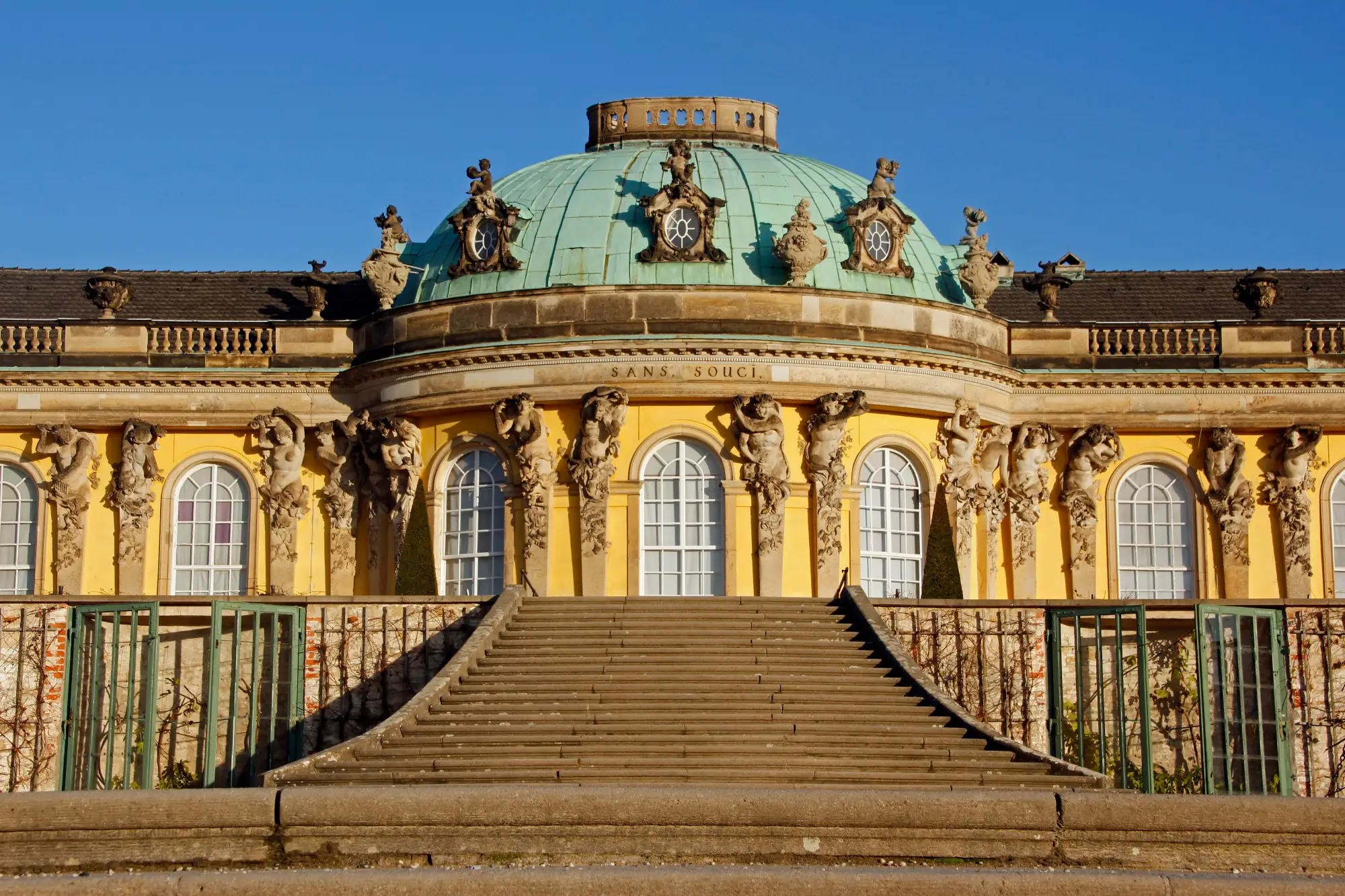
No visit to Potsdam would be complete without exploring Sanssouci Park, one of the city's most iconic attractions. Often compared to Versailles, this extensive park is a masterpiece of landscape design, dotted with elegant palaces, ornamental gardens, fountains, and romantic pathways.
At its heart stands Sanssouci Palace, the former summer residence of Frederick the Great, King of Prussia. Built between 1745 and 1747, the palace was designed as a private retreat where the king could escape the pressures of court life and indulge in his passions for music, philosophy, and the arts.
The name Sanssouci comes from the French phrase meaning “without worries” or “carefree.” It perfectly reflects Frederick's desire for a peaceful sanctuary away from the responsibilities of ruling. The king, an admirer of the French Enlightenment, famously maintained a close intellectual relationship with the philosopher Voltaire, who spent several years at the Prussian court.
One of the palace's most striking features is its terraced vineyard, with six broad terraces climbing the southern slope. Grapevines and fruit trees grow alongside the steps leading up to the palace, creating a distinctive combination of horticulture and royal architecture. The view from the top is particularly beautiful, especially when the gardens are in bloom.
But Sanssouci Palace is only the beginning. The sprawling park contains several other remarkable landmarks:
The New Palace: Located at the western end of the park, this enormous Baroque palace was built after the Seven Years' War as a demonstration of Prussia's power and prestige. Its grand halls, elaborate interiors, and impressive dome make it a striking contrast to the more intimate Sanssouci Palace.
The Chinese House: This charming garden pavilion combines European Rococo design with fanciful interpretations of Chinese art and culture. Its gilded figures and decorative details reflect the 18th-century European fascination with East Asia.
The Orangery Palace: Inspired by Italian Renaissance villas, this elegant building features a long façade, ornamental gardens, and terraces overlooking the surrounding landscape.
Fun fact: Frederick the Great was reportedly so attached to his dogs that he wanted to be buried alongside them. His tomb is located on the upper terrace of Sanssouci, and visitors often leave potatoes on it in reference to the king's role in promoting potato cultivation in Prussia.
Allow several hours to explore the park properly. The grounds are extensive, and wandering between the different buildings is part of the experience. If you want to tour the palace interiors, check the current opening arrangements and book timed admission in advance, particularly during the busy summer season.
2. The Dutch Quarter: A Little Piece of the Netherlands
In the heart of Potsdam lies one of the city's most distinctive neighbourhoods: the Dutch Quarter, or Holländisches Viertel. With its red-brick façades, white window frames, charming gables, and intimate streets, it feels as though a small corner of the Netherlands has been transported to Brandenburg.
The quarter consists of around 150 red-brick houses arranged in four blocks. It was built between 1734 and 1742 under Frederick William I, the “Soldier King,” who wanted to attract skilled Dutch craftsmen and settlers to Potsdam. Dutch builders and artisans were valued for their expertise, and the king hoped their arrival would help develop the city.
Today, the Dutch Quarter is one of the most pleasant places in the city for a leisurely walk. Its streets are lined with independent boutiques, cafés, restaurants, antique shops, and art galleries. Small courtyards and colourful shopfronts give the neighbourhood a relaxed, lived-in atmosphere that contrasts beautifully with Potsdam's grand royal palaces.
It is also an excellent place to stop for coffee, enjoy a meal, or browse local handicrafts. Throughout the year, the quarter hosts markets and seasonal events, with the Dutch-themed Christmas market being a particular highlight.
3. Cecilienhof Palace and the New Garden: Where World History Was Made
Set within the peaceful New Garden (Neuer Garten), Cecilienhof Palace is one of Potsdam's most historically significant landmarks. While it may look more like an English country manor than a traditional royal palace, its understated appearance conceals a remarkable past.
Cecilienhof was commissioned by Crown Prince Wilhelm, the eldest son of Kaiser Wilhelm II, and his wife, Crown Princess Cecilie. Constructed between 1913 and 1917, it was the last palace built by the House of Hohenzollern, the dynasty that ruled Prussia and later the German Empire.
Designed in an English Tudor Revival style, the palace features red-brick walls, half-timbered details, steep roofs, and numerous chimneys. Its architecture makes it stand out among Potsdam's more overtly Baroque and Neoclassical royal residences.
However, Cecilienhof's place in world history was secured in the summer of 1945, when it hosted the Potsdam Conference. Following Germany's defeat in the Second World War, the leaders of the victorious Allied powers met here to discuss the future of Europe and postwar Germany.
The conference brought together Harry S. Truman of the United States, Winston Churchill - and later Clement Attlee - of the United Kingdom, and Joseph Stalin of the Soviet Union. Their negotiations addressed issues such as the administration of occupied Germany, reparations, the reorganisation of Europe, and the terms of the postwar settlement.
Inside the palace, visitors can see historic conference rooms and learn about the negotiations that helped shape the postwar international order. The round table used during the conference remains one of its most evocative features.
But also the flower-shaped red star displayed in the courtyard of Cecilienhof, which was created from geraniums, became an instantly recognisable symbol of the 1945 conference and remains one of the most photographed details of the palace.
4. Glienicke Bridge: The Legendary Bridge of Spies
Few places in Potsdam capture the tension and intrigue of the Cold War quite like Glienicke Bridge (Glienicker Brücke). Spanning the Havel River between Potsdam and Berlin's Wannsee district, this elegant steel bridge once was one of the most famous symbols of espionage and East–West rivalry.
After the Second World War, the bridge stood on the border between the American sector of West Berlin and the Soviet-controlled territory surrounding Potsdam in East Germany. Access was heavily restricted, and the bridge became associated with secret intelligence operations and prisoner exchanges.
Its most famous exchange took place on 10 February 1962, when American U-2 pilot Francis Gary Powers, captured by the Soviet Union after his reconnaissance aircraft was shot down, was exchanged for Soviet intelligence officer Rudolf Abel. The exchange occurred at the same time as the release of American student Frederic Pryor at another crossing point.
These and other dramatic events earned the bridge its enduring nickname, the “Bridge of Spies.”
The location became even more widely known through popular culture, particularly Steven Spielberg's 2015 film Bridge of Spies, starring Tom Hanks. Although the film dramatises the events surrounding the Powers–Abel exchange, it helped introduce the bridge's real history to a new generation.
5. Museum Barberini: A World-Class Art Museum in the Historic Centre
For art lovers, Museum Barberini is an essential stop in Potsdam's historic city centre. Located on the Old Market Square (Alter Markt), the museum combines a beautifully reconstructed historic façade with modern exhibition spaces and an ambitious programme of temporary exhibitions.
The building takes its inspiration from the original Palais Barberini, a Baroque palace constructed in the 1770s under Frederick the Great. The original structure was severely damaged during the Second World War and later demolished. The present building was reconstructed as part of the wider redevelopment of Potsdam's historic centre and opened as a museum in 2017.
One of the museum's great strengths is its changing exhibition programme. Rather than focusing on a single permanent collection, Museum Barberini regularly brings together important works from international museums and private collections. Its exhibitions explore a broad range of artistic movements, periods, and themes, making it an appealing destination even for visitors who have been before.
The museum is particularly well known for its presentations of Impressionist art, including landscapes, studies of light, and scenes of everyday life. These works offer a wonderful complement to Potsdam's gardens and palaces, where nature, architecture, and artistic vision are closely intertwined.
There is so obviously so much more to see and explore but if you only have one day we recommend to prioritise Sanssouci Park and Palace, the Dutch Quarter, and the historic centre around Museum Barberini. With more time, add Cecilienhof and the New Garden, then finish with a visit to Glienicke Bridge.

Written by
Jules Graf
Jules (Juliane) is a Berlin-based tour guide who was born in the GDR to a family of historians. She holds degrees in Cultural Studies, Northern European History, and German Literature from Humboldt University. Having previously guided in London, Athens, and Munich, Berlin remains her favorite city.
Related stories

Practical Tips • History • 12 min. read
A Guide to Public Transport in Berlin
Metro, Trams, Busses, Trains: Everything you need to know about public transport in the German capital!

Culture • Food • 9 min. read
Food in Berlin: 11 traditional German dishes
Explore food in Berlin with this guide to 11 traditional German dishes. Learn about authentic local meals and what to eat during your visit.
Practical Tips • 5 min. read
Is Berlin Good for Families? A Guide to Parks, Museums, and Transport
Planning a family trip to Germany's capital? Discover Berlin's spacious parks, interactive museums, and practical tips for navigating public transport with kids in this helpful guide.
Culture • 4 min. read
Post-Wall Berlin: The Origins of Alternative Culture
Discover how the fall of the Wall in 1989 transformed Berlin into a hub of street art, techno, and alternative culture through abandoned spaces.
Culture • Practical Tips • 4 min. read
The 7 best souvenirs to buy in Berlin
Your guide to Berlin's best souvenirs. Find authentic GDR memorabilia, Ampelmann figures, Currywurst sauce, and local street art prints.